
Toss a chair?

Updated: Oct 8
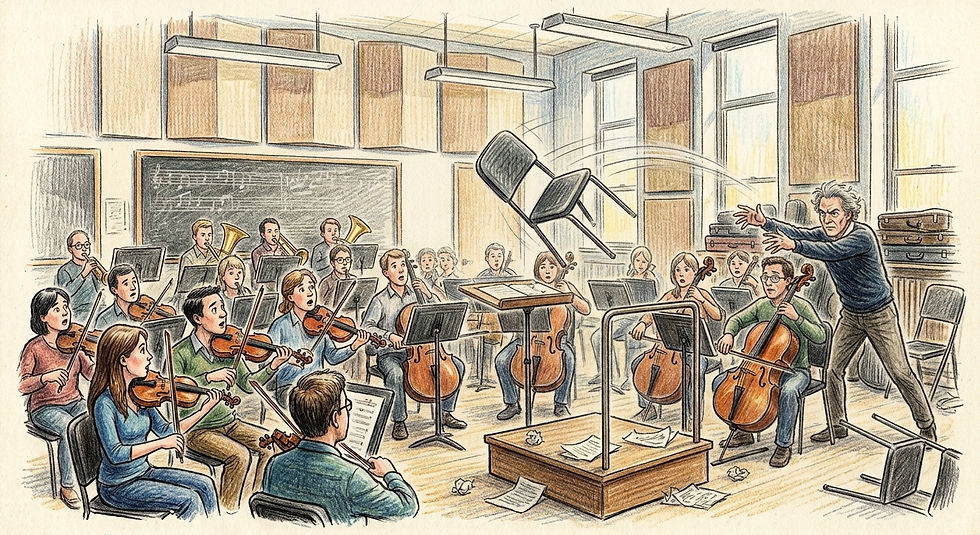
In a recent conversation with a leader, we were discussing anger and its different uses. I shared that dercades ago I was talking with a conductor friend on the phone during a break in his rehearsal. At the end of the conversation, he said, “Well, I have to go toss a chair.”
“Toss a chair?” I asked. He explained that his musicians had become complacent and weren't listening, so he needed to wake them up. He was going to go back into rehearsal, throw a chair into the middle of the room, and let his anger get their attention.
I remember that conversation because he wasn't simply losing his temper, he was using anger as a leadership technique. He believed that if he demonstrated enough anger, people would understand that he meant business and would respond accordingly. And it probably worked. I’m sure they paid attention.
he was using anger as a leadership technique
Anger can be an extremely effective way to get people's attention—in the short term. When people aren't listening, standards have slipped, or an organization has become complacent, an angry outburst can create an immediate jolt. But there are costs that may not be immediately apparent. We may regret our sharp words later, particularly when we realize that our response was more severe than the situation warranted. We may also scar someone with those words, even though we have forgotten the incident by the next day. And we can damage our reputation as leaders if people begin to know us as someone who has to get angry before people pay attention.
There is another organizational cost that may be even more serious. Once people learn that anger is how we respond when things go wrong, they may begin managing our emotions instead of managing the work. They may withhold bad news, avoid difficult conversations, or simply spend their energy trying not to become the next target.
Once people learn that anger is how we respond when things go wrong, they may begin managing our emotions instead of managing the work.
My own thinking about anger has gone through several stages. At first, I essentially believed in emotional Newtonian physics: for every action there should be an equal and opposite reaction. If someone did something that angered me, I responded with an amount of anger proportional to the infraction. In time, I discovered that this was highly ineffective.
So I looked to philosophy and religion and encountered the idea of righteous anger. There seemed to be plenty of examples of gods demonstrating righteous anger, so perhaps anger wasn't always wrong and there were circumstances in which it was justified. I tried that, too, and concluded that it wasn't particularly effective either.
I've now arrived at a different formulation: If there is such a thing as righteous anger, it is reserved for the gods. Since I'm not one of them, I should try to remove anger from my leadership repertoire.
That doesn't mean I never feel angry. Anger is a feeling and we must feel our feelings. Yet as a follower of Stoicism, I remind myself that another person doesn't make me angry. Something happens, I experience a reaction, and then I have a choice about what I do with that reaction. I may not be able to choose the feeling, but I can choose how I respond to and with it. And when I choose not to respond in anger, I am refusing to give another person control of me. I remain in control of me.
The Buddhist teacher Thich Nhat Hanh approaches anger differently from the Stoics, but I find something useful in his perspective as well. He encourages us to pay attention to the suffering underneath anger rather than simply acting it out. For him, the opposite of anger isn't passivity; it is understanding—understanding ourselves, understanding the other person, and understanding the interaction that produced the conflict. That understanding gives us more choices. I can still confront someone, express disappointment, say that something is unacceptable, hold someone accountable, and impose consequences without hurting me, humiliating them or showing disdain. Especially at work, these are people we see every day. I don't want something I say or do today to haunt my tomorrows.
being firm without being angry is often more powerful than being angry.
In fact, I have come to believe that being firm without being angry is often more powerful than being angry. A leader who can calmly say, “This is unacceptable, and here's what needs to change,” may command more respect than the leader who throws the chair. Anger can be useful information. It can tell us that something matters, that a boundary has been crossed, or that we need to pay attention. But anger is information, not instruction.
anger is information, not instruction.
The question isn't whether I have a right to be angry. The question is whether anger is the best leadership tool for the situation. For me, it rarely is.


Comments